









 GLM TEAM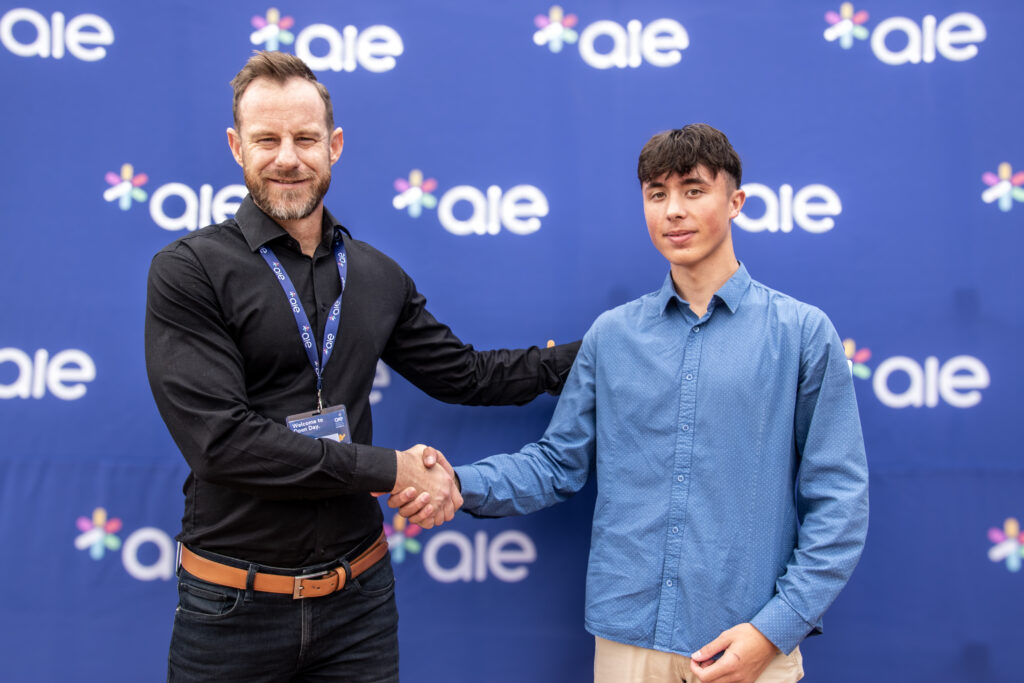
Two of the happiest moments of matriculants’ school careers are the day they receive favourable matric results, and the day they are accepted into the tertiary institution of their choice. But for many, one of the hardest is realising that attending may not be possible due to financial challenges. For Andrew Stoltz and Jandre de Lange, residents at the Bethany House Trust children’s home in Krugersdorp, that dream is still alive today thanks to the Academic Institute of Excellence (AIE).
AIE has awarded full bursaries to both students for the 2026 academic year, covering 100% of their tuition fees. Stoltz aims to complete the Occupational Certificate: Real Estate Agent, empowering him to achieve his dream of building a career that helps families secure homes while simultaneously creating a stable future for himself. This NQF Level 4 qualification offers a regulated, industry-recognised entry into the real estate sector, combining theory with the practical requirements needed to operate professionally.
Advertisements
De Lange, whose interest lies in technical drawing and design, will pursue the Multi-Disciplinary Draughting National Certificate – a technical qualification aligned with design, construction, and infrastructure-related industries. Draughting remains a core skill across many industries, supporting fields from residential development to engineering and manufacturing.
The two bursaries were initially awarded at 50% of the course value, but were subsequently upgraded to full funding following a closer review of the students’ commitment, aptitude, and readiness to take the next step into structured, career-focused education.

AIE CEO Leon Smalberger notes, “Further study often represents a particularly narrow window for young people transitioning out of school, especially for those who don’t have financial safety nets to fall back on. Once that window closes, returning becomes far more difficult. Full funding removes uncertainty from the equation, allowing students to plan, commit, and move forward with certainty.”
The role of private education in supported transitions
Bethany House Trust has worked in child protection and youth development since 1998, supporting children and young people who have experienced abuse, neglect, abandonment, and severe vulnerability. Operating primarily in Gauteng, with a strong presence in the West Rand, the organisation reaches more than 100,000 beneficiaries annually across its programmes. Education forms a central pillar of its work, offering young people a route toward independence and long-term stability.
“Every child deserves the opportunity to better their knowledge and skills, and become productive members of society, regardless of background,” says Smalberger. “When students meet the academic requirements placed before them, lack of funding should not be a reason they are unable to move forward. For students like Andrew and Jandre, who have shown growth and incredible determination in the face of significant challenges, a helping hand is well-deserved. We are proud to offer them that support.”
The shared initiative between AIE and Bethany House Trust is an ideal model for how institutes and humanitarian organisations can work together to open doors to further education for learners who need it most. Non-profit organisations (NPOs) bring a deep understanding of the social and emotional challenges young people face, while education providers bring structure, accreditation, and industry alignment.
“South Africa cannot rely on goodwill alone to address post-school structural gaps. Private institutions have a key role to play in creating pathways to further education. When this role is taken seriously, the return in terms of young people’s lives and futures is immeasurable. These bursaries are by no means charity, but rather a strategic investment in South Africa’s future – a principle we continually strive to advance,” Smalberger concludes.
About The Author


Subscribe To Our Weekly Newsletter